Over the past few years, the digital advertising ecosystem has become increasingly complex. A single impression can pass through multiple intermediaries before reaching an advertiser. Each additional hop adds cost, reduces transparency, and increases the risk of duplication or inefficiency.
At the same time, advertisers are under pressure to justify every euro or dollar spent. Agencies are optimizing toward measurable outcomes. Publishers want a stronger yield without losing control of their inventory.
This is where Supply Path Optimization (SPO) becomes essential. SPO is a practical framework for reducing unnecessary intermediaries, improving auction dynamics, and building more direct, efficient relationships between buyers and sellers.
In 2026, SPO is about three things:
- Reducing redundant paths
- Increasing transparency
- Improving performance per impression
What Is Supply Path Optimization?
Supply Path Optimization is the process of analyzing and streamlining the routes through which advertisers access publisher inventory in programmatic advertising.
In simple terms, it means choosing the most efficient path to buy media.
When advertisers bid on impressions, they often access the same inventory through multiple supply-side platforms (SSPs) and resellers. This creates duplicated bid requests, inconsistent pricing, and unnecessary fees.
SPO aims to:
- Identify which supply paths deliver the highest-quality impressions
- Eliminate redundant or low-performing intermediaries
- Consolidate spend toward trusted, high-performing SSP partners
For advertisers and agencies, SPO improves cost efficiency and auction clarity.
For publishers, it helps prioritize demand partners that provide consistent value rather than fragmented, duplicated traffic.
For SSPs, it means building transparent infrastructure, clean auction mechanics, and direct publisher relationships that justify long-term partnerships.
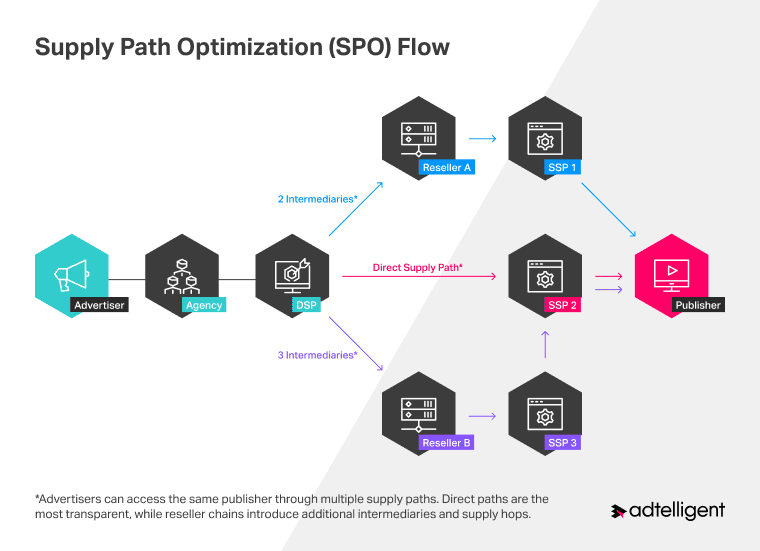
Digiday notes that the growing need for supply path optimization is driven by bid duplication and the complexity of auction dynamics, especially in a header bidding environment.
How Ecosystem Works With and Without SPO
To understand SPO, it helps to look at what actually happens during a programmatic transaction.
1. The Ad Request
A user opens a webpage or app.
The publisher’s ad server sends an ad request to one or multiple SSPs.
If the publisher works with several SSPs and resellers, the same impression may be offered through multiple supply paths at the same time.
2. Bid Request Distribution
Each SSP packages the impression into a bid request and sends it to connected DSPs.
Here’s where duplication can happen:
- The same impression appears through different SSPs.
- Each path may include different fees.
- Auction dynamics can vary slightly between platforms.
From the buyer’s perspective, this creates noise. The DSP may receive multiple bid requests for what is essentially the same opportunity.
3. Auction and Bid Evaluation
The DSP evaluates each bid request based on:
- Price
- Inventory quality
- Historical performance
- Deal terms
- Fee structure
- Path transparency
Without SPO, buyers may bid across multiple paths blindly, increasing costs and reducing efficiency.
With SPO, buyers analyze historical data to determine:
- Which SSP consistently delivers better win rates
- Which path results in better performance (CTR, CPA, ROAS)
- Which partners offer clearer fee structures
- Which integrations reduce latency
They then consolidate spend toward those preferred supply paths.
4. Winning Bid and Impression Delivery
Once the DSP selects the optimal path and wins the auction, the ad is served to the user.
The result:
- Fewer duplicated bids
- Lower technical overhead
- Better cost efficiency
- More predictable auction behavior
In short, SPO introduces intentional decision-making into what used to be a fragmented, multi-hop system.
SPO vs DPO: What’s the Difference?
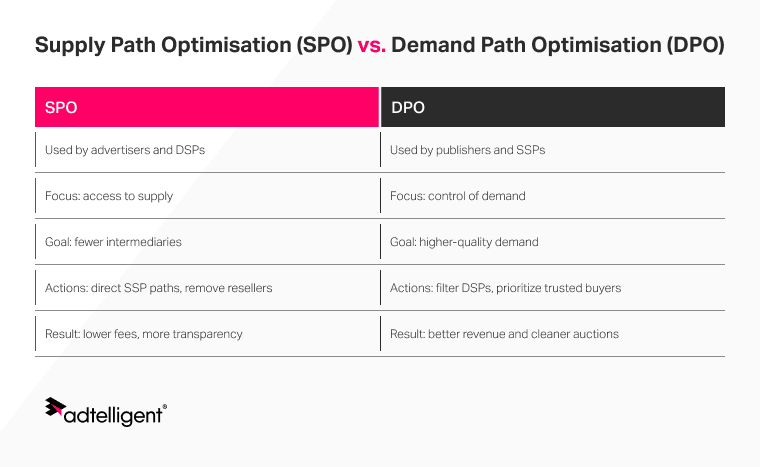
Supply Path Optimization (SPO) and Demand Path Optimization (DPO) are often mentioned together, but they focus on opposite sides of the ecosystem.
SPO (Supply Path Optimization)
SPO is typically driven by buyers — advertisers, agencies, and DSPs.
Its goal:
- Optimize how buyers access supply
- Reduce redundant SSP relationships
- Consolidate spend toward efficient, transparent partners
It answers the question:
“What is the best path to access this inventory?”
DPO (Demand Path Optimization)
Demand Path Optimization (DPO) is driven by publishers and SSPs.
Its goal:
- Optimize which demand sources compete for inventory
- Prioritize buyers who bring consistent spend and higher yield
- Reduce low-quality or duplicative demand
It answers the question:
“Which demand partners create the most value for this impression?”
The Challenges of Traditional SPO Approaches
In theory, SPO is simple: analyze performance, reduce duplication, consolidate spend.
In reality, it’s more nuanced.
Early SPO strategies often focused heavily on cutting costs. Buyers reduced SSP partnerships based on basic metrics like CPM or win rate, without fully understanding auction dynamics or the quality of underlying publisher relationships. This sometimes led to short-term savings but long-term inefficiencies.
Another challenge is limited transparency. It’s not always clear whether inventory is direct or reseller-based, how many intermediaries are involved, or how fees are structured. Without visibility into these mechanics, SPO decisions can become assumptions rather than informed optimizations.
Data fragmentation also complicates the process. DSP and SSP reporting don’t always align, log-level access can be restricted, and attribution models vary. This makes it difficult to compare supply paths consistently and objectively.
Finally, SPO is not a one-time adjustment. Auction behavior, floor strategies, and demand patterns constantly evolve. Without ongoing monitoring and collaboration between buyers, publishers, and SSPs, optimization efforts quickly lose relevance.
Effective SPO in 2026 requires more than consolidation. It requires transparency, data clarity, and continuous refinement.
Learn more about trends in programmatic advertising in 2026!
Core Components of Adtelligent’s SPO
Effective Supply Path Optimization is not just about analytics.
It depends on technical standards that make supply transparent and verifiable.
Three elements form the foundation of SPO: ads.txt, sellers.json, and schain (SupplyChain Object).
ads.txt: The First Layer of Supply Transparency
ads.txt is one of the key building blocks of SPO.
Buyers increasingly prioritize inventory where:
- ads.txt is correctly configured
- Direct relationships are clearly declared
- The number of resellers is limited
From a buyer’s perspective, clean ads.txt signals lower risk and fewer unnecessary intermediaries. It simplifies validation and reduces ambiguity in the supply path.
As an ad server, Adtelligent provides structured ads.txt management tools. Publishers can configure and manage their authorized sellers directly through the interface, including advertiser-specific settings. This reduces manual errors and ensures consistency across integrations.
In SPO strategies, properly maintained ads.txt files directly influence trust and bid prioritization.
sellers.json: The Structural Map of the Supply Chain
If ads.txt validates who is allowed to sell inventory, sellers.json explains how that inventory is sold.
Buyers use sellers.json to understand:
- Who is a direct seller
- Who operates as an intermediary or reseller
- How many hops exist between publisher and buyer
This information is central to SPO analysis. It allows DSPs and agencies to evaluate supply paths structurally — not just based on performance metrics.
Without accurate sellers.json data, it becomes difficult to assess the true efficiency of a transaction path.
Sellers.json serves as the transparency layer that enables informed consolidation decisions.
schain (SupplyChain Object): Real-Time Path Visibility
While ads.txt and sellers.json provide static transparency, schain delivers dynamic, request-level visibility.
The SupplyChain Object passes detailed information in every bid request about:
- Each entity involved in the transaction
- The order of intermediaries
- Whether each participant is direct or indirect
Buyers analyze schain data in real time. In many cases, they prioritize bid requests where the supply path is shorter and more direct.
As an ad server, Adtelligent supports full schain transmission and provides interface-level management of these settings. This allows publishers to maintain accurate supply chain signaling without complex manual configuration.
In modern SPO environments, schain data often determines which bid requests receive priority and budget allocation.
How to Get Started with SPO at Adtelligent
SPO is not only about strategy. It’s about execution.
At Adtelligent, publishers and partners can directly manage the key transparency components (ads.txt and schain behavior) through the platform interface. This allows structured, controlled SPO implementation without technical overhead.
1. Managing ads.txt via Advertiser Settings
In Adtelligent SSP, ads.txt lines can be managed individually for each advertiser.
This setup allows centralized configuration of all ads.txt entries that must appear in a publisher’s file. It simplifies compliance with the IAB ads.txt standard and improves clarity for demand partners.
📍 Where to find it:
Advertisers → Advertiser Settings → Ads.txt
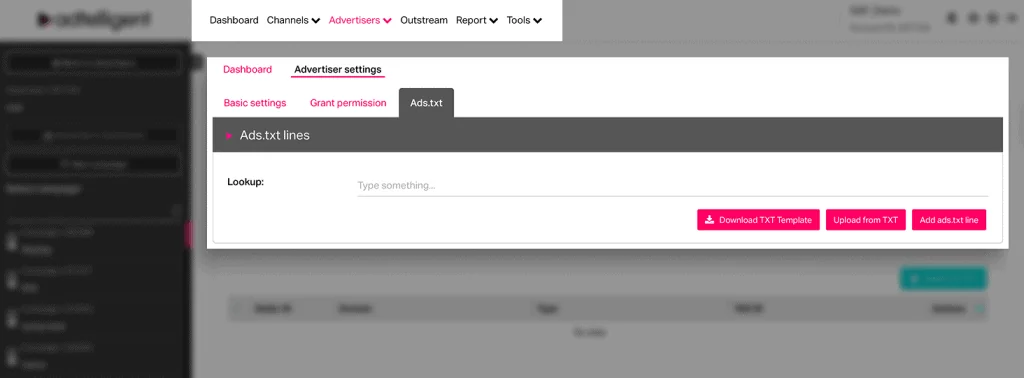
Available Actions
Within the Ads.txt tab, users can:
- Add ads.txt lines manually
- Import lines from a .txt file
- Download a blank template for offline preparation
- Export existing entries to TXT for review or backup
Adding an ads.txt Line
To create a valid entry, click “Add ads.txt line” and complete the required fields:
- Seller ID (required) – Unique advertiser ID
- Domain (required) – Advertising system domain (e.g. advertiser.com)
- Type (required) – Must be DIRECT or RESELLER
- TAG ID (optional) – Certification authority ID
At minimum, Seller ID, Domain, and Type must be filled for the line to be valid.
Proper ads.txt configuration directly impacts SPO effectiveness. Buyers often prioritize inventory where:
- Direct relationships are clearly declared
- Reseller chains are limited
- Seller information matches SSP records
Clean ads.txt files reduce ambiguity and increase bid confidence.
2. Configuring SupplyChain (schain) Object Behavior
SPO decisions increasingly rely on real-time supply chain visibility. That’s where schain configuration becomes critical.
This allows clients to control how supply chain data is transmitted in outbound ad requests.
📍 Where to find it:
Channel Settings → Schain Object Behavior
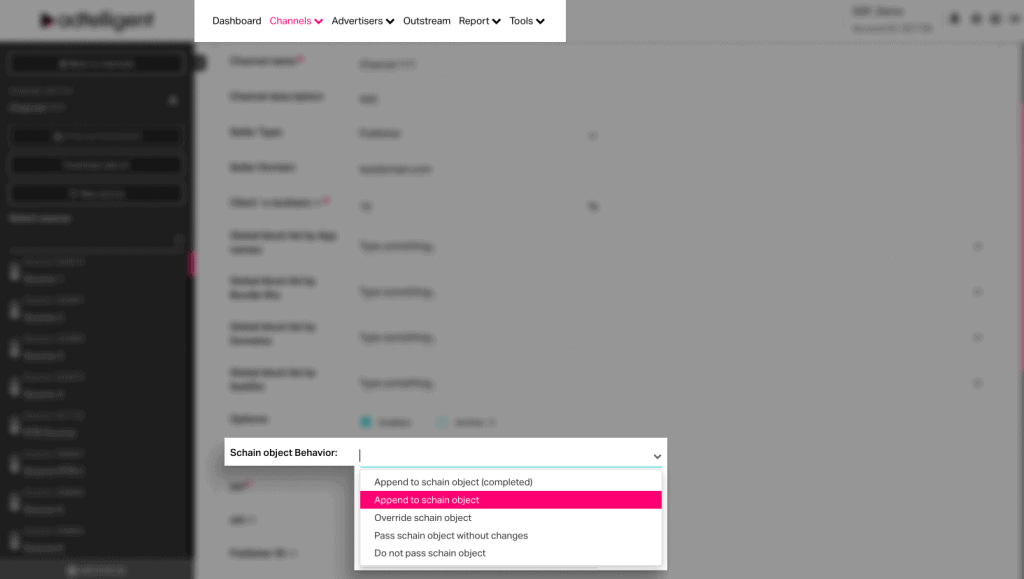
Available Schain Behavior Options
Adtelligent provides five configuration modes:
- Append to supply chain
- Append to supply chain (completed)
- Override supply chain
- Pass schain without changes
- Do not pass supply chain
Depending on the selected option, the platform will append, overwrite, forward, or suppress schain data.
When selecting Append or Override options, two additional fields appear:
- asi (required) – Canonical domain of the advertising system (must match ads.txt if available)
- sid (optional) – Seller ID associated with the system (defaults to channel ID if left empty)
How Buyers Use Schain in SPO
DSPs analyze schain data in every bid request to determine:
- How many hops exist in the chain
- Who is direct vs intermediary
- Whether the supply chain is marked complete
- Whether the SSP initiating the request is transparent
In many cases, shorter and cleaner supply paths receive priority.
By allowing structured control over schain transmission, Adtelligent helps publishers maintain transparent and optimized supply signaling.
3. Campaign-Level Control and Universal Lists
For more granular management, schain SID and ASI values can be configured at campaign level via Universal Lists.
If both Channel Settings and Campaign Lists are configured, campaign-level settings take priority.
Additionally, schain transmission can be disabled at campaign level using the “Pass schain” toggle in Advanced Settings.
When disabled, no schain data is sent — regardless of channel configuration.
Real Use Cases & Results
Across the board, we see measurable impact when SPO components are properly implemented.
First, improved buyer uptake.
Inventory with correctly configured ads.txt files, transparent sellers.json data, and properly transmitted schain objects tends to receive stronger demand participation. Buyers are more confident bidding when they can clearly understand who is selling the inventory and how many intermediaries are involved.
Second, schain has become increasingly important.
Demand-side platforms are placing greater emphasis on supply chain transparency. Many DSPs now analyze schain data at the bid-request level. Traffic without schain details (or with incomplete supply chain signals) often sees lower bid density and reduced win rates.
In practice, this means:
- Cleaner supply paths receive higher prioritization
- Shorter chains improve bid confidence
- Transparent sellers attract more stable demand
Publishers that actively manage their ads.txt and schain configuration typically see stronger auction participation compared to those that treat these settings as static compliance tasks.
SPO today is directly connected to revenue consistency.
Final Thoughts
Supply Path Optimization is evolving. What started as a cost-efficiency initiative is now a structural requirement for participating in modern programmatic ecosystems.
In 2026 and beyond, SPO will likely become more automated and data-driven. DSPs will continue refining how they evaluate supply paths, factoring in transparency signals, hop count, historical performance, and auction behavior in real time.
At the same time, publishers and SSPs will need to move beyond basic compliance. Managing ads.txt, sellers.json, and schain settings will no longer be optional technical tasks, they will be active levers for yield optimization.
Platforms that provide structured transparency tools and flexible configuration will be better positioned to support both sides of the market.