
In 2026, identity in advertising means using signals in a way that respects user trust.
The shift is already clear in the data.
- 67% of advertisers use alternative IDs to reach non-addressable traffic, but most don’t rely on them alone.
- Private marketplaces (57%), clean rooms (51%), and publisher IDs (50%) are now widely used, showing that identity strategies are becoming more layered.
- 84% of respondents already use or plan to test identity graphs to connect different identifiers across devices.
As a result, modern identity setups combine first-party data, various ID types, contextual signals, and clean rooms to avoid exposing personal data.
Today’s leading identity frameworks don’t rely on a single identifier. What do they combine? Deterministic and probabilistic signals, contextual data, authenticated environments, and clean-room logic.
Table of Contents
Top 10 ID Solutions in 2026
- ConnectID – Integrated approach working for an addressable environment.
- ID5 – Encrypted, privacy-first ID for targeting and measurement.
- Intent IQ – Cookieless ID combining contextual and identity signals.
- myGaru – Privacy-first ID + data clean room using consented telecom data; strong for CTV and omnichannel without exposing PII.
- Panorama ID – Interoperable identity spine for cross-channel reach.
- PPID – Publisher-provided, deterministic first-party ID.
- Prebid Transaction ID – Open-source ID for measurement and frequency.
- RampID – People-based ID linking offline and online data safely.
- SharedID – Publisher-controlled ID within the Prebid ecosystem.
- UID2 (Unified ID 2.0) – Open, consent-based alternative to cookies.
What Is an ID Solution?
An ID solution helps recognize users or devices without violating privacy rules. It allows companies to understand interactions across devices and platforms while respecting user consent and data protection requirements.
ID solutions are used in many industries, not only in advertising. They support things like secure logins, fraud prevention, personalization, and cross-device experiences. In digital advertising specifically, they help advertisers target audiences, measure campaign performance, and optimize results without relying on traditional tracking methods.
As third-party cookies continue to disappear from browsers, ID solutions have become a key alternative. In 2026, most solutions are built on first-party data, user consent, encryption, and open integrations. This approach helps advertisers and publishers keep digital advertising working in a cookieless and highly regulated environment while maintaining transparency and user privacy.
Types of ID Solutions for Ads Explained
Deterministic IDs
Deterministic IDs use known, consented data like login emails, phone numbers, or publisher IDs. This data is usually hashed or encrypted before use.
Best for: accuracy, measurement, attribution, CTV, logged-in users
Downside: limited reach if users aren’t logged in
Probabilistic IDs
Probabilistic IDs don’t use direct identifiers. They rely on signals like device data, context, IP ranges, and behavior to estimate identity.
Best for: scale and reach in anonymous traffic
Downside: less accurate and more sensitive to regulation
Hybrid Approaches
Hybrid solutions combine deterministic data when it’s available with probabilistic or contextual signals to increase reach while staying privacy-safe. Most modern ID solutions work this way.
Best for: omnichannel campaigns and the cookieless web.
Top 10 ID Ad Solutions in 2026
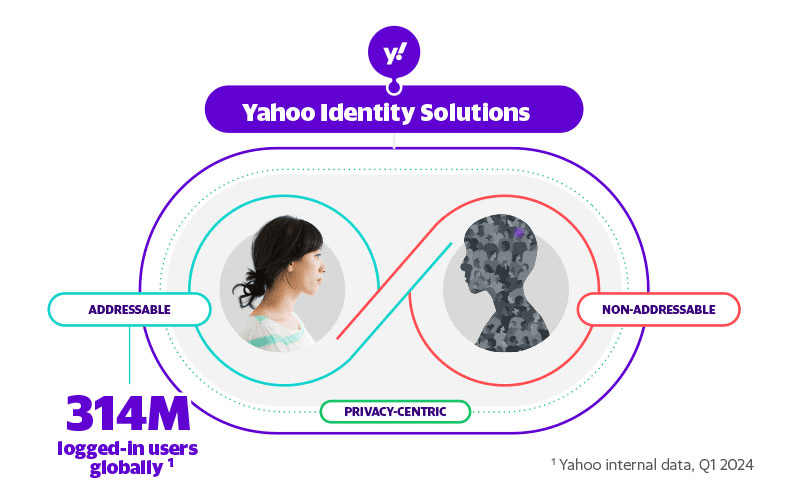
ConnectID by Yahoo
ConnectID is a privacy-focused ID that helps advertisers and publishers work in a world with fewer identity signals. It supports addressable advertising where user consent and privacy matter.
Best use case: Cookieless scale with full publisher data control.
ID5
ID5 provides an encrypted, privacy-first ID that works across platforms without exposing personal data. It’s widely adopted and built with compliance in mind.
Best use case: Cross-channel targeting, frequency control, and measurement on web and CTV.
Intent IQ
Intent IQ combines identity, contextual, and behavioral signals to reach audiences without cookies. It balances reach and accuracy using both deterministic and probabilistic data.
Best use case: Expanding reach in anonymous traffic while staying privacy-compliant.
myGaru
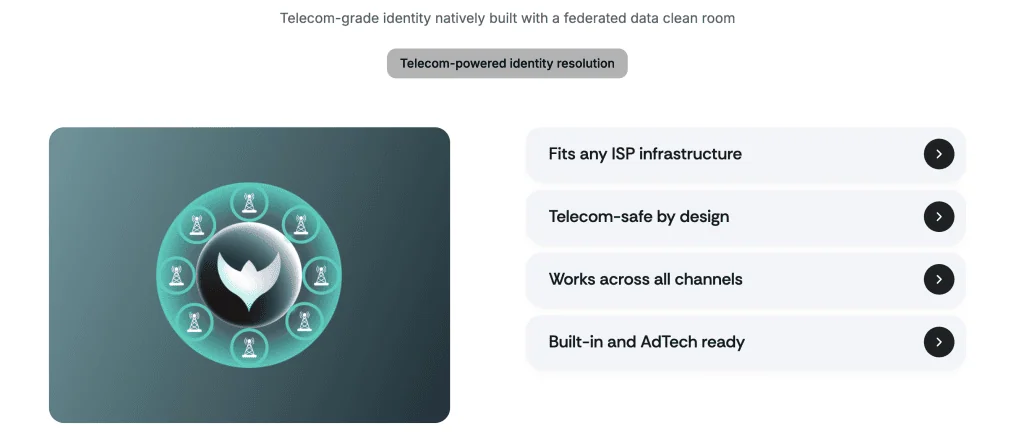
myGaru is a privacy-first identity and data clean room solution built on consented, telecom-grade data.
The platform offers a new way to target advertising without using personal data or static identifiers, which can create privacy risks and often work inefficiently. myGaru helps companies work with data while keeping user privacy protected. For advertisers, it also makes it possible to connect different digital channels, such as OTT, in-app, and web, and deliver more personalized communication.
At the same time, users receive more relevant but less intrusive advertising, while maintaining full online anonymity.
Best use case: Omnichannel and CTV advertising, clean-room-based activation, and privacy-safe measurement where accuracy, compliance, and scale must coexist.
Panorama ID by Lotame
Panorama ID works as a central identity layer that connects disparate data sources into a single system. It helps match audiences across channels while keeping privacy and flexibility in mind.
Best use case: Advertisers and publishers who want a single view of audiences across web, mobile, and CTV.
PPID (Publisher Provided ID)
PPID serves as a first-party ID launched and run by publishers. It’s usually based on logged-in users and is supported by most major ad platforms, which makes it very accurate.
Best use case: Targeting and measurement in premium, logged-in publisher environments.
Prebid Transaction ID
The Prebid Transaction ID is an open-source ID generated during the ad auction. It doesn’t identify users directly, but it supports features such as frequency capping and campaign measurement in Prebid.
Best use case: Publishers who want a simple, transparent ID for measurement without sharing user data.
RampID by LiveRamp
RampID is a people-based ID that safely connects offline and online data. It’s built for large-scale identity resolution and supports advanced activation and measurement use cases.
Best use case: Big advertisers and platforms that need cross-channel measurement and data onboarding.
SharedID by Prebid
SharedID is a first-party ID that stays under publisher control. It improves addressability on the open web while allowing publishers to retain ownership of their data.
Best use case: Publishers looking for a straightforward, cookie-free alternative.
Unified ID 2.0 (UID2) by The Trade Desk
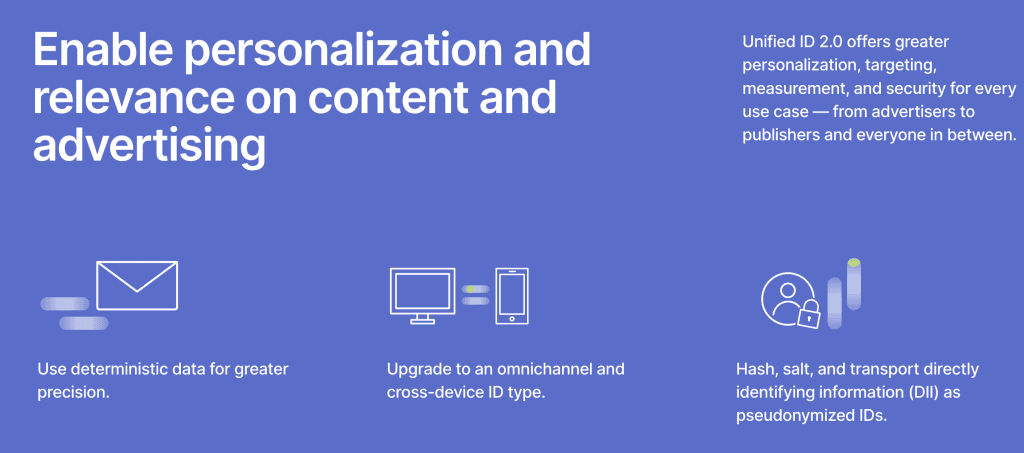
UID2 is an open-source ID based on hashed email addresses and clear user consent. It’s designed to give advertisers addressability while giving users more control over their data.
Best use case: Addressable advertising and measurement in authenticated and premium environments.
*The list of top solutions is presented in alphabetical order.
How to Choose the Right ID Solution for Your Stack
When you’re choosing an ID solution, start with a few basic questions.
- Where does your data come from?
If you have strong first-party data, such as logins, subscriptions, or CRM data, deterministic IDs will deliver the highest accuracy. If you don’t, hybrid solutions can help you extend your reach more safely. - Which channels matter most to you?
For web-only campaigns, publisher IDs may be enough. But if you work with CTV, omnichannel, or DOOH, you need IDs that work outside the browser. - How strict are privacy and regulation in your markets?
Markets with strict consent and data residency rules demand privacy-by-design solutions and clean-room-based activation. - Do you need more reach or more precision?
Deterministic IDs favor precision. Hybrid approaches balance scale and performance. Most mature stacks use both. - Can the ID integrate with your existing stack?
Your ID solution should integrate easily with SSPs, DSPs, ad servers, and clean rooms. Closed systems can slow you down later.
At Adtelligent, we provide technology tools to help companies implement privacy-focused identity solutions. Our approach supports platforms that enable individuals to take control of their personal data, while giving businesses access to GDPR-compliant first-party data for responsible audience targeting and measurement.
There is no single “best” ID solution in 2026. The right choice depends on your business model, channels, and data maturity. Strong adtech stacks treat identity as a flexible layer, not a one-size-fits-all replacement for cookies.
Common Pitfalls to Avoid
Even privacy-first ID strategies can fail if implemented poorly. Here are the most common mistakes seen across the industry:
- Relying on a single ID solution
Identity fragmentation is real. Stacking complementary IDs is now standard practice. - Ignoring consent mechanics
An ID without clear, auditable user consent creates legal and reputational risk. - Optimizing only for scale
More reach doesn’t always mean better results. Poor-quality signals hurt performance and measurement. - Using identity only for targeting
IDs are also critical for measurement, frequency control, and attribution. - Getting locked into closed ecosystems
Vendor lock-in reduces transparency and makes it harder to adapt as rules and channels change.
Final Word
In 2026, identity will require a flexible, above all confidential, foundation that operates across channels, platforms, and legal frameworks.
The most effective strategies combine diverse identity solutions, trusted first-party data, and a clean environment. Brands and publishers that understand identity as a core infrastructure have the best prospects for the future.
FAQ
What is an ID solution in advertising?
An identity solution is a privacy-safe method of recognizing users or devices that enables targeting, measurement, and attribution without third-party cookies.
Are ID solutions GDPR-compliant?
Yes, if they are built around explicit user consent, encryption, and data minimization. Compliance depends on implementation, not just the technology.
Is one ID solution enough?
No. Most adtech stacks use multiple ID solutions to balance scale, accuracy, and channel coverage.
What works best for CTV and omnichannel advertising?
Deterministic and hybrid IDs combined with clean-room activation perform best, especially in privacy-regulated markets.
Do ID solutions replace contextual targeting?
No. Identity and contextual targeting work best together, especially as privacy expectations increase.
Will ID solutions keep changing after 2026?
Absolutely. Identity will continue evolving toward cleaner, more interoperable, and regulation-ready frameworks.