
If you’ve spent any real time inside an ad ops dashboard, you’ve probably caught yourself wondering whether your ad server and your SSP are doing the same thing, or stepping on each other’s toes. It’s a fair question. The names sound technical, the categories overlap, and most vendors aren’t exactly rushing to clear it up for you.
Here’s the short version: they’re not the same, they don’t compete, and most publishers running a serious operation in 2026 are using both. Let’s get into why that is, and what it actually means for your stack.
Table of Contents
TL;DR: Ad Server vs SSP
- An ad server runs the show. It decides which ad gets delivered, when, and to whom, like your decision engine.
- An SSP (supply-side platform) is your route to programmatic demand. Think of it as the channel that brings buyers to your inventory.
- They serve very different jobs, which is exactly why most publishers run both.
- Platforms like Adtelligent let publishers stay in charge of how SSP demand actually gets used, instead of just handing the keys over.
What Is Ad Server?
An ad server is a tool that manages, optimizes, and delivers ads on websites or apps, video live-streaming inventory, etc. It connects your ads with the right audience in real-time.
Modern ad servers also offer some advanced capabilities like real-time bidding (RTB), AI optimization, and detailed audience segmentation. They support omnichannel monetization, allowing publishers to manage and sell ad inventory from a single platform, maximizing fill rates and revenue efficiency.
In practical terms, an ad server handles:
- Placement and inventory management
- Delivery logic (which ad fires for which request)
- Prioritization — what beats what
- Targeting and pacing
- Direct campaigns and sponsorships
If you’ve sold a guaranteed campaign to a brand for a fixed CPM and need to deliver, say, 2 million impressions over 30 days with frequency capping at three per user — that’s ad server territory. Same for sponsorships, takeover units, or any deal where you’ve made a promise that has to land exactly the way you sold it.
So in plain terms: the ad server is your control layer. It’s where strategy happens, not just monetization. (For a deeper walkthrough, this ad server guide is a solid read.)
What Is SSP (Supply-Side Platform)?
An SSP, or supply-side platform, is your gateway to programmatic demand. While the ad server worries about what to show, an SSP is focused on who’s willing to pay, and how much.
Here’s what an SSP actually does:
- Connects your inventory to DSPs and ad exchanges
- Runs real-time bidding (RTB) auctions on every impression
- Fills inventory you haven’t sold directly
- Optimizes yield across competing demand sources
- Aggregates demand from dozens (sometimes hundreds) of buyers at once
Where an ad server is about precision and control, an SSP is about reach and revenue. It’s the part of your stack that makes sure unsold inventory doesn’t go to waste, and that whatever does get sold goes to the highest bidder available in that millisecond.
The honest tradeoff: SSPs give you access to demand, but they don’t give you much say in how that demand gets prioritized once it enters the auction. That’s a feature, not a bug — programmatic only works if the auction is fast and rule-light. But it’s a key reason publishers don’t run on SSPs alone.
Ad Server vs SSP: Key Differences
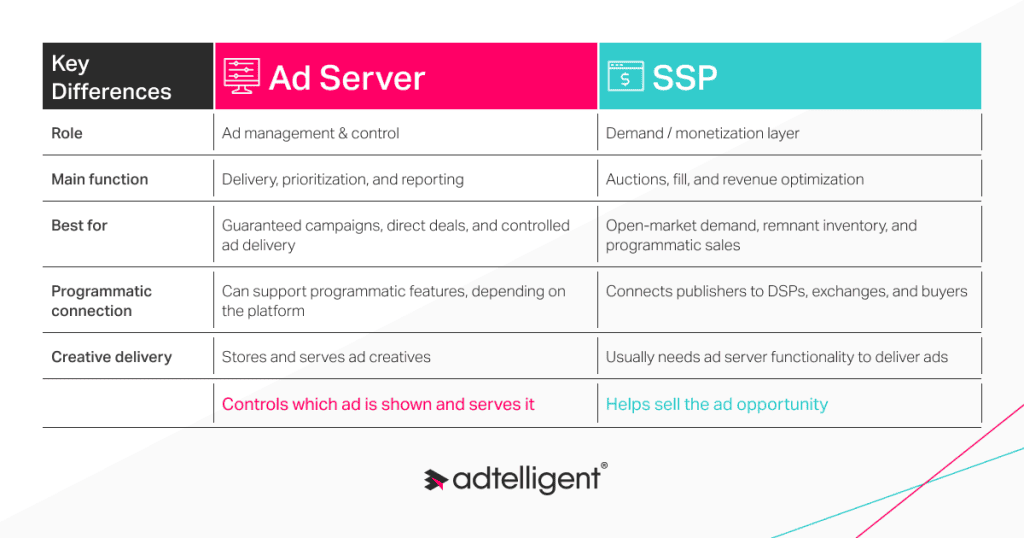
Look at it this way: the ad server is the venue, with the lights, the rules, and the bouncer at the door. The SSP is the booking agent bringing in talent. Both matter. Neither in ad server vs SSP battle does the other’s job well.
How Ad Servers and SSPs Work Together
The flow is simpler than people make it sound. Here’s what actually happens when a user opens a page:
- The browser fires an ad request.
- The ad server checks its rules — direct campaigns, sponsorships, priority tiers.
- If a directly-sold campaign matches, it serves. Done.
- If nothing matches (or remnant inventory is up for grabs), the request falls through to the SSP.
- The SSP runs an auction. Winner gets the impression.
- The ad server delivers the winning creative and logs the result.
Notice who’s in charge the whole time: the ad server. Even when the SSP wins the slot, it’s the ad server that hands off the request and tracks what actually rendered. That handoff is everything. A publisher who skips the ad server is a publisher who’s outsourced their decisioning to whoever happens to be running the auction.
Why the Line Between Ad Server and SSP Is Blurring
Here’s where things get messy. Modern ad servers increasingly support RTB-like features, like header bidding integration, dynamic price floors, and deal-based prioritization.
SSPs, on their end, have been quietly adding ad serving capabilities, such as creative management and basic delivery rules. At the same time, they often drive innovation by introducing new ad formats (especially in CTV, native, and video) and more advanced optimization algorithms that improve how inventory is priced, matched, and served in real time.
The result is that the strict ad server vs SSP framing is starting to feel a little dated. The smarter question for 2026 isn’t “which one do I need” but “is my stack actually unified, or am I duct-taping two halves together and hoping the seams hold?”
When Do You Need an Ad Server vs an SSP?
When You Need an Ad Server
- You sell direct campaigns and need delivery guarantees
- You’re managing custom placements across multiple properties
- Your business depends on customization or running a white-label setup
- You need granular campaign control: pacing, frequency, targeting at scale
When You Need an SSP
- Your priority is maximizing revenue on unsold inventory
- You want broad access to programmatic demand
- You’d rather automate auctions than chase deals manually
When You Need Both
Honestly? Most of the time. Anyone running a real publishing business, direct sales plus open-market monetization, needs both layers working together. Picking just one is usually a sign that someone’s about to leave money on the table.
Common Misconceptions
A few things people get wrong, often:
- “An SSP replaces my ad server.” No. It replaces nothing. It adds a demand source. Treating an SSP like a full ad server means losing control over priority, pacing, and direct deals — three things you really don’t want to lose.
- “My ad server can’t handle programmatic.” Not true anymore. Modern ad servers integrate cleanly with header bidding, RTB, and PMP deals. The line really has moved, even if the marketing copy hasn’t quite caught up.
- “You only need one tool.” Sure, if you only have one revenue stream. But most publishers don’t, and the ones who try to consolidate too aggressively usually regret it within a quarter or two.
How Adtelligent Combines Ad Server and SSP
This is where Adtelligent comes in. Instead of forcing publishers to glue an ad server to an SSP and pray the integration holds, Adtelligent runs both as a full-stack solution under one roof.
What that actually means in practice: unified infrastructure across web, mobile, and CTV; control over how SSP demand competes against your direct deals; and automation that doesn’t strip out your ability to set the rules. You get yield optimization and auction-based monetization without giving up the ad server’s strategic layer.
A few specifics worth flagging: privacy-first data handling, full transparency through ads.txt, sellers.json, and schain support, plus built-in ad fraud protection. None of that is glamorous, but in 2026, it’s the difference between a clean monetization stack and one that quietly bleeds revenue to bad actors.
Key Trends in 2026: Where Ad Serving Is Going
A few things shaping where this is all headed:
- AI is showing up everywhere in monetization. From bid prediction to creative optimization, machine learning is becoming the default rather than the differentiator.
- Supply Path Optimization (SPO) is no longer optional. Buyers are aggressively cutting unnecessary intermediaries, and publishers who can’t show clean, direct paths are getting passed over.
- The privacy-first ecosystem is maturing. Cookieless targeting, first-party data strategies, and consent management have moved from “nice to have” to baseline requirements.
- CTV and retail media keep eating share. If your stack can’t serve those formats well, you’re missing where the growth actually is. (Worth checking out the top CTV ad platforms if this is your wheelhouse.)
Final Thoughts
The whole “ad server vs SSP” framing kind of misses the point. It’s not really a versus situation. The real question is whether your monetization stack is flexible, scalable, and actually working for you rather than the other way around.
If you’re spending more time managing the gaps between your tools than running campaigns, that’s a stack problem, not a tooling problem. Want to see what a unified, full-stack alternative looks like in practice? Adtelligent’s ad platform is built to help publishers monetize more efficiently — without the duct tape.
FAQs
What’s the difference between an ad server and an SSP?
An ad server controls how ads get delivered and prioritized. An SSP connects your inventory to programmatic demand and runs auctions. One is about control, the other is about revenue.
Can an SSP replace an ad server?
Not really. An SSP doesn’t manage direct campaigns, sponsorships, or guaranteed delivery the way an ad server does. They solve different problems, and replacing one with the other usually breaks something important.
Do publishers need both?
Most do. If you’re running any mix of direct deals and programmatic monetization, yes — both layers matter, and they each pull their weight in different parts of the funnel.
How does programmatic advertising work?
At a high level: a user requests a page, an ad opportunity is detected, an auction runs across DSPs and exchanges, the highest bidder wins, and the ad gets delivered — all in roughly 100 milliseconds.
What is RTB?
Real-time bidding. It’s the auction mechanism that decides who buys a given impression. Each time an ad slot loads, eligible buyers submit bids, and the winner serves their creative — essentially live, in real time.