
TL;DR
This blog post explains that Ad Servers and Demand-Side Platforms (DSPs) serve distinct but complementary roles in modern advertising. An Ad Server is responsible for managing, optimizing, and delivering ads across websites and apps — ensuring creatives load quickly, appear in the right placements, and reach relevant users. It allows marketers to upload ads, set targeting rules, control sequencing, and track performance. Modern ad servers also support RTB, AI-driven optimization, audience segmentation, and omnichannel delivery across web, mobile, CTV, and DOOH. A DSP, in contrast, is built for programmatic media buying. It enables advertisers to bid on impressions in real time, apply data-driven targeting, and optimize spend across multiple exchanges and channels at scale. The comparison of ad server vs DSP emphasizes that these tools are not interchangeable: most advanced advertising setups rely on both, with the DSP handling buying and the Ad Server ensuring precise delivery, control, and measurement.
Table of Contents
Key Differences of Ad Server vs. DSP
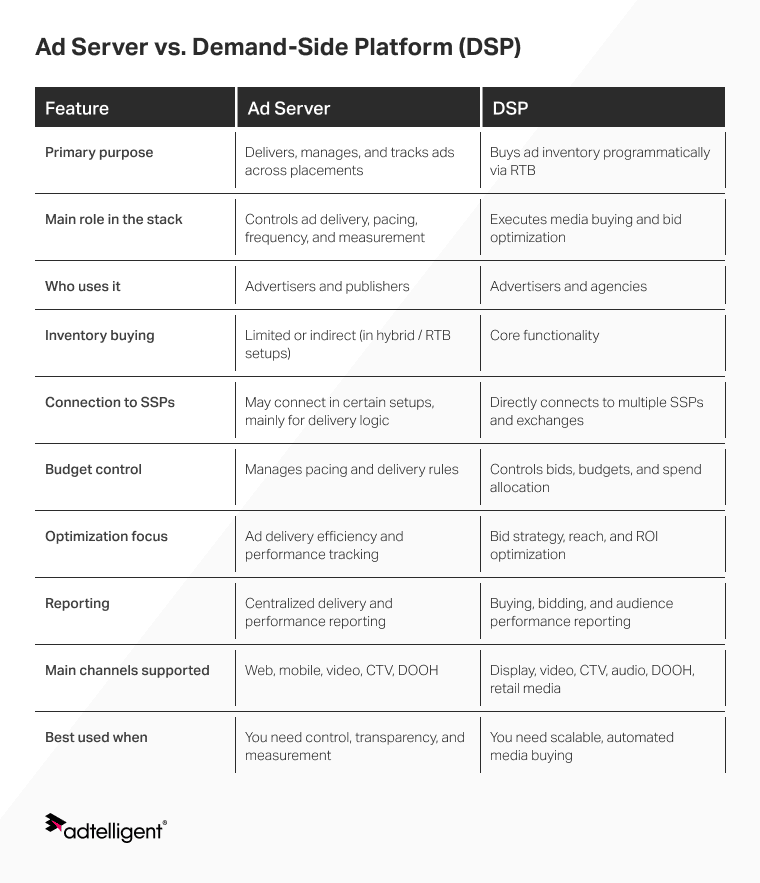
When it comes to major differences between an ad server and a DSP, there are several things to keep in mind:
- DSPs focus exclusively on real-time bidding, while ad servers primarily support tag-based, waterfall, or header bidding.
- The main users of DSP are advertisers and special agencies, while the opponent is usually used by publishers and ad networks.
- DSP has limited and predefined targeting attributes, while ad servers feature custom, unlimited ones.
- DSP gives basic control of the process, with minor adjustment possibilities, and an ad server offers full control with source code access, rotations, and custom pacing.
- DSP’s inventory sources are SSPs and ad exchanges, while ad servers take information from direct publishers.
- DSP optimization tools involve rule-based bidding and AI auto-bidding. Ad servers guarantee full transparency, as well as manual or API-based optimization.
- DSP offers real-time analytics with basic granularity, and ad servers suggest raw logs and custom breakdowns, but not in real time in most cases.
What Is an Ad Server?
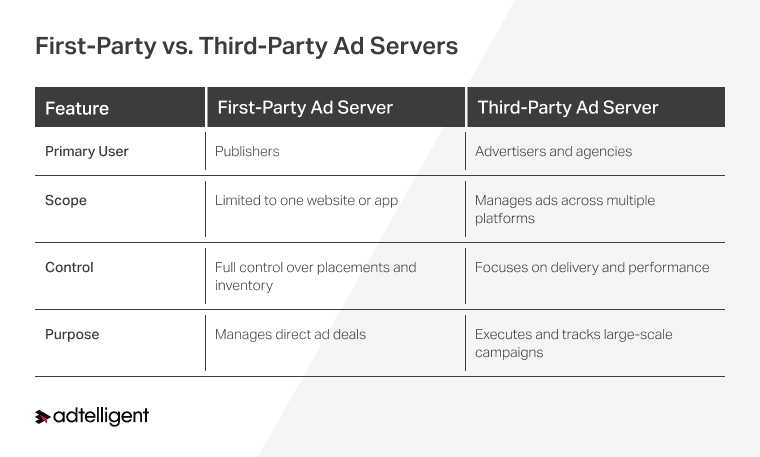
An ad server is a web server that contains all the advertisement information and is responsible for placing advertisements on the site. It is used for launching and managing online advertising campaigns using a direct approach. The main task of this server is to match users with the most relevant advertisements by means of user data, page content, and campaign rule analysis.
Find all the details about the ad server types, features, and use cases here!
What Is a DSP?
A demand-side platform is a platform created for buying digital ad space, also known as inventory, through real-time bidding (RTB). This platform connects with different supply-side platforms (SSPs), compares incoming bid requests, and places bids based on parameters set by the advertiser — a capability that modern ad servers may also support in certain RTB or hybrid setups, though with different priorities and limitations. You can specify the target audience, bid limits to take careful control of the budget, creatives that appear to be more attractive to users, and performance goals, and the DSP will automate the process across a variety of sites to place the highest bid and win the auction.
Eager to know the best DSPs in 2026? We’ve got you covered!
How Ad Servers and DSPs Work Together
It is important to emphasize that these two solutions deliver better results and help achieve KPIs faster when combined. The best approach is to run an advertising campaign via an ad server, using custom templates, direct sales, and rotation logic. But if your inventory isn’t filled, the system sends a request to the DSP platform, which will select the most suitable bidder. A blend of these tools leads to a range of benefits:
- a unified campaign management;
- better audience insights;
- improved control over data and brand safety;
- enhanced ROI;
- streamlined workflow.
Don’t lose a chance to take advantage of a more efficient approach to managing advertising inventory with Adtelligent, a company that knows how to achieve a perfect blend of DSPs and ad servers for your advertising campaign success.
Common Misconceptions
Speaking of the Ad Server vs DSP, you can come across different misconceptions. Let’s debunk the most popular myths:
- DSP replaces the ad server. This fact isn’t true since they have different main functions: DSP focuses on buying inventory, while an ad server manages, delivers, and tracks advertisements on different platforms.
- Ad server is only for publishers. Publishers are primary users of ad servers, but not the only ones. They also include advertising networks, sites, gaming studios, video streamers, etc.
- DSP controls advertisement delivery directly. This fact misguides users since the advertisement delivery is controlled by SSPs.
- The same reporting is provided by the same tool. Both tools give insights and offer reports, but these reports are different and contain various data.
When You Should Use Both Tools
Both DSPs and ad servers may become a powerful tool when used together. They seem to be the most effective when you deal with the following tasks:
- Running omnichannel campaigns. Both these tools create a powerful omnichannel engine, where DSPs deal with data-driven audience targeting and programmatic buying using RTB, while ad servers manage direct publisher deals, frequency capping, and ensure consistent tracking.
- Using different channels like CTV, display, and video. DSPs automate buying across different channels (like CTV via SSPs), and ad servers provide control, custom logic, and cross-channel measurement for campaigns.
- Better attribution and frequency control. Ad servers take the responsibility of the brain responsible for tracking and measurements, and DSPs deal with automated real-time buying and targeting.
- Cross-platform measurement. Both these tools help to optimize ad spend, streamline workflow, and improve performance.
As advertisers diversify their DSP usage, the need for a centralized ad server increases. According to a Digiday survey, advertisers have significantly expanded the number of DSPs they use over the last year and a half, making ad servers critical for unified delivery, frequency control, and performance tracking across platforms.
Final Word & Recommendations
The combination of DSPs and ad servers can be powerful, helping advertisers and other professionals achieve their goals more quickly and effectively. If you use both tools, you can expect to maximize reach and advertising efficiency, gain greater control and flexibility, improve transparency, enable data-driven optimization, and achieve unified campaign management.
Naturally, the maximum benefit can be achieved if you deal with professionals who know how to use these tools more effectively and make the most of this combination.
FAQ
Do I Need Both an Ad Server and a DSP?
It depends on the goal of your advertising campaign. Both these tools perform their specific goals. Together, they create a complete advertising workflow, with the DSP buying the inventory and the Ad Server ensuring ads are delivered and measured correctly.
Can a DSP Replace an Ad Server?
No, it can’t. An ad server performs tasks that a DSP doesn’t support.
Is Google Ads a DSP or an Ad Server?
Google Ads is a self-serve advertising platform, so it doesn’t belong to any of the tools mentioned.
What Is the Difference Between an Ad Server and an SSP?
An SSP helps publishers sell and optimize ad inventory, while an ad server focuses on delivering, managing, and tracking ads across placements and channels.
Some modern ad servers combine multiple functions. For example, we offer a full-stack infrastructure that helps publishers optimize programmatic revenue through transparent, data-driven yield management.