In digital advertising, speed and flexibility are crucial. Companies looking to take advantage of programmatic advertising often face a high barrier to entry, including significant infrastructure development and support costs. Publishers, media groups, and ad networks are no longer satisfied with relying entirely on third-party platforms that dictate pricing models, branding, and demand access.
There is a simpler and more affordable option: white-label solutions. Instead of building an ad platform from scratch (a process that can take years and significant investment), businesses can launch their own branded programmatic infrastructure using proven technology.
A white label ad platform allows companies to operate a fully functional advertising platform under their own brand while relying on an established ad tech provider for the underlying technology and infrastructure.
What Is a White Label Ad Platform?
A white-label ad platform is a customizable programmatic ad solution that enables publishers or media companies to use their own branded interface to manage and sell their ad space. It can include ad server, SSP, and/or DSP functionality.
An ad tech business builds and keeps up the technology, but publishers, advertisers, and partners see the platform as the company’s own product. This means that in real life, firms can run their own advertising marketplace without having to construct the technology from scratch.
They get the tools they need for infrastructure, integrations, and optimization, but they still have control over branding, monetization plan, and partnerships.
How a White-Label Ad Platform Works
A white-label SSP connects publisher inventory with many demand sources through real-time bidding, just like any other supply-side platform.
The process typically goes like this:
1. Inventory Setup
First, publishers configure their inventory inside the platform. They add ad placements, define floor prices, choose supported formats, and set targeting rules.
2. Real-Time Auction
When a user loads a webpage or opens an app, the SSP sends a bid request to connected demand partners such as DSPs and ad exchanges.
3. Bid Selection and Ad Delivery
Those buyers evaluate the impression and submit bids in real time. The highest eligible bid wins, and the ad is served to the user.
4. Performance Analytics
Meanwhile, the platform collects performance data (impressions, revenue, engagement) helping publishers figure out what works and optimize their monetization strategy.
This approach allows publishers to monetize inventory efficiently while giving buyers access to valuable audiences.
Why Businesses Choose White-Label Ad Platform
Many companies choose a white label ad platform (in this case, white-label SSP) instead of relying only on third-party platforms. There are a few simple reasons for this.
- Brand ownership. With a white label ad platform, the platform runs under your own brand. Your logo, domain, and dashboards are visible to clients and partners. For ad networks and media companies, this is important because the platform becomes part of their product.
- More control over monetization. Companies decide how their inventory is sold. They choose pricing rules, partners, and targeting settings. Traditional SSPs often limit these options. White-label platforms give more flexibility.
- Faster launch. Time is a valuable resource, especially in the field of advertising technologies. Creating and launching your own platform from scratch can take months or even years and is accompanied by high costs. White label ad platforms enable companies to respond more quickly to market needs.
- Branded reporting. Data helps teams understand performance and grow revenue. With a white-label SSP, all data can be shown in your own branded dashboards, so clients see insights under your brand.
- Saved resources and focus on business. Using a ready-made white-label solution helps significantly reduce platform development and support costs. There’s no need to maintain a team of developers, engineers, or support specialists since everything is already ready and tested.
Who Gains from a White-Label Ad Platform?
- Publishers with high traffic volumes get full control over pricing, partners, and inventory. They operate under their own brand, not a third-party SSP. This means fewer restrictions and more flexibility in how they monetize traffic.
- Ad networks/agencies utilize white label ad platforms to create a programmatic platform that is branded with their own name. This lets businesses give their clients and partners access to just one platform.
- Media groups and technology companies can start providing advertising services without building their own ad tech from the ground up. A white-label SSP gives them the tools they need to start quickly.
- Ad agencies can control supply directly instead of relying only on external SSPs. This gives them more transparency, better margins, and more flexibility in deals with advertisers.
White-Label SSP vs Traditional SSP
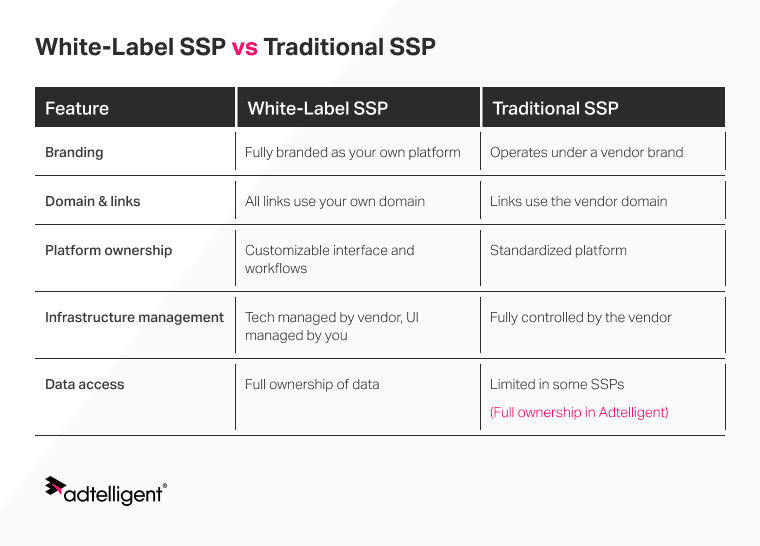
For companies that want to build their own advertising ecosystem, white-label solutions offer a more strategic approach.
What to Look for in a White Label Ad Platform
- Support for different ad formats. The white label ad platform should support common formats like display, video, and native ads. It should also work across different devices, including desktop and mobile.
- Demand integrations. The platform should allow easy connection to DSPs and ad exchanges, usually through standard protocols like OpenRTB.
- Clear analytics and reporting. Real-time reports and simple dashboards help teams track performance. This makes it easier to understand what works and where revenue can improve.
- Optimization tools. Automation can help improve ad performance. They can adjust settings and help increase revenue over time.
- Scalable infrastructure. As traffic grows and more partners join, the platform should still work smoothly. A strong SSP can handle higher volumes of auctions and impressions without slowing down.
Launch Your Own Ad Platform with Adtelligent
If your company wants to run its own programmatic platform, Adtelligent offers a white-label SSP that makes this possible.
The solution is built for publishers, ad networks, and media companies. It allows businesses to launch their own branded advertising platform while using Adtelligent’s technology and infrastructure.
Platform with Full Branding
“With Adtelligent’s white-label ad platform, your brand runs the platform. You can change the platform domain, the interface, the dashboards, and the reports. This makes sure that your clients and partners have the same experience every time. It also helps your business grow and gives you a professional place to advertise.” – Mariia Kopytko, Senior Customer Success Manager at Adtelligent Inc.
Support for Multiple Ad Formats
The platform supports a wide range of ad formats, including:
- Display
- Video
- Native
- Audio
- Search, etc.
This allows businesses to monetize inventory across multiple channels and devices.
Advanced Targeting and Optimization
The platform offers detailed targeting options. Campaigns can be adjusted by location, device type, language, and other parameters.
Real-time analytics and optimization tools help improve performance and increase revenue.
Built to Scale
The platform is designed to grow with your business. Companies can add new publishers, demand partners, and inventory as their operations expand.
Checklist: Launch Your White-Label Ad Platform with Adtelligent
Use this checklist to get your white-label SSP up and running.

To learn more about Adtelligent’s White-Label SSP solution, request a demo and explore how it can support your advertising strategy.
A Faster Way to Enter the Programmatic Market
As advertising operations expand, the platform can scale to support additional publishers, new demand partners, and higher auction volumes.
White-label platforms are an excellent choice for companies looking to quickly carve out a niche in the advertising technology world without spending years and billions on developing their own solutions.