
Programmatic advertising is an adtech (advertising technology) element. Programmatic advertising is a method for marketers to use technology to automate procedures such as bidding, requesting, and negotiating for online ads.
Table of Contents
Top Programmatic Advertising Trends
- AI – AI drives smarter targeting, bidding, and optimization across programmatic campaigns.
- OTT and Connected TV – Streaming and CTV continue to attract brand and performance budgets as viewing shifts away from linear TV.
- DOOH and Retail & Commerce Media – Programmatic expansion brings scale and measurable performance as retail media consolidates.
- Switch to Alternative IDs – Privacy-first IDs and first-party data replace third-party cookies.
- Podcasts and Voice Assistants – Audio ads grow through high-engagement, voice-first environments.
According to the statistics below, it has been one of the most rapidly growing segments of modern advertising:
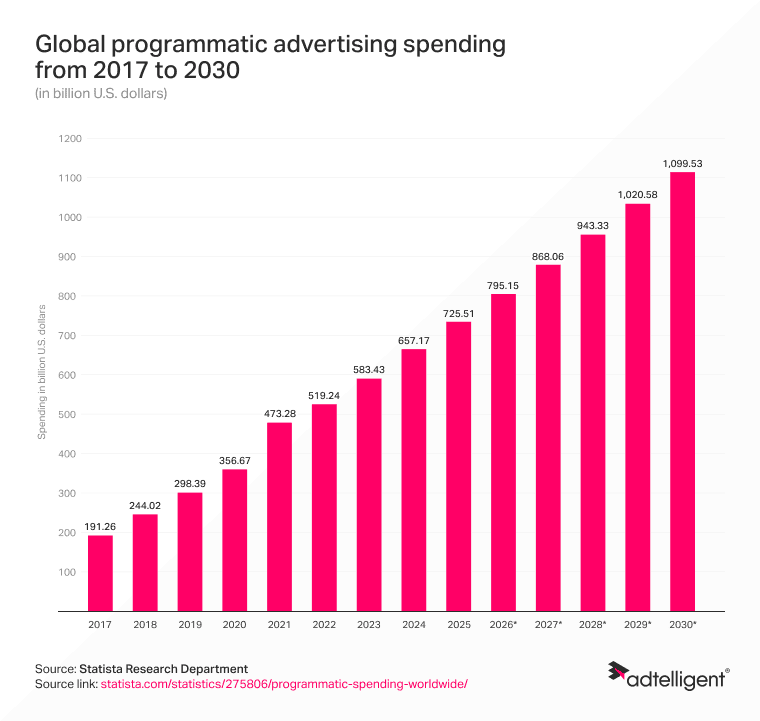
This tactic uses algorithms and tools to determine, order, and, eventually, purchase some much-needed ad space. It allows marketers to optimize the ad copy, the targeting and, ultimately, create a marketing plan with specific KPIs and target audience that will do the brand’s efforts justice across all marketing platforms.
The main trend among programmatic advertising trends in 2026 is the widespread use of artificial intelligence. It automates ad buying, optimization, and placement based on demographics, behavior, and context. AI is also applied in search and social network advertising, among other contexts. Another major trend affecting the entire market is the transition from third-party cookies to alternative identifiers, particularly first-party data. This shift fundamentally alters the landscape of the digital advertising market. But what is it that will shape programmatic advertising trends for this year – and beyond?
AI Is Golden
Programmatic advertising already uses AI, which makes it a lot more efficient. AI allows programmatic advertising to use data to educate itself and measure and optimize ad performance,
From the ad’s position to the channel, device, copy, and visuals, AI offers valuable data that marketers can use to create a personalized ad message.
Through AI, marketers can study the audience more holistically since AI can distinguish between millions of patterns that marketers—or humans, for that matter—can not see. It can also map the customer journey effectively, pinpoint the optimal course of action, and improve strategy and planning.
Another reason AI will continue to dominate programmatic advertising trends and the marketing actions that it can help boost is the fact that it can combine and analyze a wide variety of data: from age, educational background, and gender to the preferred device according to gender or age, or purchases per geographic location, AI can create segments updated with real-time data.
AI can also allow marketers to create buyer personas similar to a brand’s ideal customer as the customers themselves.
AI uses data from previous transactions, behavioral data, geo-location, and everything that matters to create buyer personas and generate messages for these personas. Since AI-generated buyer personas can correspond to prospects one-on-one, the ad’s message is spot-on and tailor-made.
By recognizing patterns effectively, AI can allow marketers to create and place ads that will sell while reducing costs like Customer Acquisition Cost (CAC) and increasing metrics like the sought-after ROI.
Amazon, Google, Meta, TikTok, and other big tech companies have already introduced AI technology into their advertising tools. They generate ideas for creatives and even create ready-made visual materials and videos. Besides, AI helps with targeting by processing huge amounts of data and helping to determine customer preferences more accurately.
However, full AI integration into the advertising industry remains a work in progress, according to IAB’s State of Data report.
Only 30% of agencies, brands, and publishers have fully adopted AI across media campaigns, though half expect to do so by 2026. The biggest barriers include data quality, security concerns, and fragmented tools, while job security is less of a concern.
OTT and Connected TV Are Here to Stay
OTT and Connected TV have become core elements in programmatic advertising trends as viewing shifts away from linear TV toward streaming. Through OTT advertising, consumers can access video content on their CTV device through their internet connection. OTT advertising is available through more means than OTT streaming services, though. This segment is growing not only in North America and Western Europe but also in other regions. In particular, OTT revenue in Eastern European countries will almost double by 2029.
By connecting TVs to the internet, CTV enables access to apps like Netflix, Apple TV, Amazon Prime Video, Spotify, and gaming consoles — turning the TV screen into a fully addressable, data-driven advertising channel.
All of the above display ads, seeing as they’re platforms that can deliver tailor-made, optimized content, especially to demographics like Millennials and Gen-Z that enjoy anything personalized far more than their predecessors (Boomers and Gen-X).
According to Digiday, 75% of advertising on CTV is already purchased programmatically, confirming the shift to scalable, data-driven advertising.
Biddable CTV is transforming media buying and programmatic advertising trends by delivering agility, efficiency, and real-time optimization. In 2026, nine streaming platforms will exceed $1 billion in ad revenue, and CTV will account for 20% of U.S. media consumption.
Moreover, in the EU, total revenues from paid streaming services (including subscriptions and advertising) surpassed public TV revenue (from taxes, licence fees, and advertising) in Europe for the first time last year.
Publishers are increasing revenue by reducing inventory losses, and advertisers are gaining more control and transparency.
More companies are investing in new CTV formats. For example, in February 2026, Samsung Smart TVs introduced a new CTV homescreen display and video ad formats that appear before content starts, turning the TV interface itself into premium ad inventory. This way, CTV advertising is expanding beyond traditional video ads into homescreen-first formats on smart TVs.
Remember that video ads are a great way to engage, so long as the content is personalized and optimized. After all, no consumer loves the idea of their screen time being interrupted by an ad. Programmatic advertising can help marketers create fewer, but more engaging, ads that “speak” to specific audiences across the right devices.
DOOH and Retail Media & Commerce Media
While OTT and CTV dominate indoor screens, programmatic advertising is also expanding rapidly into physical and commerce-driven environments through DOOH and retail media. Programmatic DOOH allows advertisers to combine location data, time of day, and contextual signals to deliver relevant ads in high-traffic places such as transport hubs, shopping malls, stadiums, and gas stations. This makes DOOH especially effective for awareness and impulse-driven campaigns.
Marketers that use DOOH for their programmatic advertising can combine location data with their ads, allowing them to write tailor-made content. This content’s reach can be immense, as brands can display their DOOH ads in train or bus stations or shopping malls. GSTV (Gas Station TV) shows video content with ads at more than 27,000 gas stations around the U.S. according to Comscore, it has approximately 115 million unique viewers each month.
Think of Times Square, for example. It is a hotspot for DOOH content that can reach more consumers. Programmatic advertising can refine DOOH using real-time behavioral data, eventually displaying a highly personalized and targeted ad.
DOOH advertising is available in Google Display & Video 360. With its simple tools, one can easily start an ad campaign in railway stations, ports and airports, sports arenas, and other places.
Retail and commerce media are also moving into a more mature stage of programmatic advertising trends. After several years of fast growth, the market is becoming more competitive, and the focus is shifting from rapid expansion to scale, efficiency, and long-term value.
According to statistics, commerce media ad spend has surged in recent years, reaching nearly $59 billion in the U.S. this year. While growth is expected to slow over the next few years, analysts predict the channel will still account for around 20% of total U.S. digital ad spend by 2029.
One clear trend is consolidation. Retailers are joining larger networks or partnerships to give advertisers broader reach and make media buying simpler. At the same time, the number of retail media adtech providers is decreasing, as smaller platforms struggle with high technology and operating costs. Large retailers are also starting to work more directly with advertisers or major platforms, reducing the role of intermediaries.
This is where modern retail media platforms play a key role. Platforms that enable unified buying, activate first-party data, and support programmatic workflows help retailers stay competitive and give advertisers the scale, transparency, and performance they expect from programmatic advertising.
Find the detailed Retail Media Outlook for 2026 here!
Switch to Alternative IDs
The elimination of third-party cookies has forced the industry to develop new, more independent solutions. For example, Adobe integration shows promise for cookieless campaigns – Adobe Real-Time CDP integrated with Utiq ID, improving privacy and targeting accuracy.
- First-party data: data obtained directly from users. This information can be used for targeting.
- Alternative identifiers that are similar in functionality to third-party cookies but comply with current privacy regulations, such as Google’s Privacy Sandbox.
- Contextual targeting is selecting an audience based on user search queries or watching similar site categories. Relevant ads are then shown to this audience.
All alternative identification technologies must not violate the privacy standards prescribed in regulations (GDRP, CCPA, etc.) and must allow the use of effective advertising strategies with targeting.
Data consolidation contributes to the programmatic advertising trends. For example, in December 2025, Nielsen made its audience segments available in Nielsen Marketing Cloud directly within Amazon Ads. The segments are based on Nielsen data (panels and external sources) and cover categories such as CPG, automotive, and finance. The integration strengthens Amazon’s position as an all-in-one platform for advertising, targeting, and measurement.
Podcasts And Voice Assistants
Podcasts are to Millenials and Gen-Z what radio was to Boomers and Gen-X. There are as many platforms for podcast hosting as there are podcasts covering all tastes and interests. This means that they can penetrate a broader audience spectrum and allow more people to engage with a brand’s ads.
Programmatic audio advertising grows faster than any other ad format. Programmatic advertising allows brands to find ad space and create and execute targeted ads for podcast listeners. Podcast ads can either be in the form of copy to be read by the host, responsible for incorporating the ad copy into the podcast’s content, or a dynamic, personalized, and tailor-made ad.
The first method is effective since it is seamless and non-invasive. The second method is effective due to how its content can be hyper-personalized.
Finally, never forget the data goldmine that is a voice assistant in programmatic advertising. Siri, Alexa, and other voice assistants can help marketers identify trends that would be impossible without using programmatic advertising.
Like podcasts, voice assistants can “display” an ad or a brand’s message by merely responding to a user’s query.
According to some estimations, the global audio streaming market is forecasted to expand to $89.77 billion by 2031, growing at a robust CAGR of 13%. Some other statistics:
- The number of global music streaming users is projected to reach 1.2 billion by 2029, with a user penetration rate of 13.3% by 2025.
- Asia Pacific is expected to account for 33.4% of the global music streaming market share, driven by the rising number of smartphone users and demand for streaming services.
- Music streaming in the United States makes up 84% of the country’s music industry revenue, reflecting a highly mature market.
- Audiobook user penetration is expected to grow from 18.7% in 2024 to 21.7% by 2029.
On May 2, 2024, IAB Tech Lab published its Technical Measurement Guidelines. The document is intended to increase consumer confidence in the podcast market, and this has already been achieved.
Brands that use cross-platform audio (online radio, live audio broadcasts, and podcasts) as part of their media strategy achieve superior campaign performance, better marketing performance, and, as a result, more revenue.
Reasons To Use Programmatic Advertising
Programmatic advertising trends encompass a toolset that can help brands improve many components of their marketing plans, such as targeting, key metrics, marketing attribution, and reporting.
The Multichannel and Metrics Benefits
Marketers can use programmatic advertising across various channels and ad networks, making it a more efficient choice than AdWords or YouTube, which share ads with their own network.
Programmatic advertising can also use all devices. Nothing is out of bounds, as you can display your ad on tablets, mobile devices, and desktops, as well as the CTV and smart billboards mentioned above.
Because of its nature, programmatic advertising uses AI. Marketers know how beneficial this can be for key marketing metrics, offering better segmentation and hyper-personalization options.
Better Targeting
Programmatic advertising allows for better targeting as well, again because it is based on AI technology.
Programmatic advertising is one tool that can help brands laser-target their audience with similar content that offers real-time data for the brand to utilize, with new segmentation options that match the user’s needs at that specific time.
This type of targeting can boost the campaigns and create similar audiences that brands can target second, expanding their reach.
Reporting
The insights brands get while using programmatic advertising are among the most valuable in the business. They’re real-time and filled with big data that can benefit all campaigns on all devices and platforms.
Tailor-made ads and laser-targeting allow marketers to look at their audience both as a group and individually. How each prospect responds to a programmatic ad can reveal a lot about their preferences, allowing marketers to analyze each customer’s behavior and see their individual responses to each marketing stimulus and their response’s impact on their demographic.
Key Takeaways
Today’s consumers move freely across platforms, content types, devices, and shopping environments, choosing what fits their needs at any given moment. Programmatic advertising trends may shift, but the consumer will always be at the center of these changes.
Google adds AI overviews to Search, Microsoft runs ads inside Copilot, Spotify offers both free and premium tiers, and Netflix, Amazon, and Disney have embraced ad-supported models. At the same time, retail and commerce media are becoming core touchpoints, allowing brands to reach consumers directly in shopping and purchase-driven contexts using first-party data. Users seamlessly switch between screens, formats, and retail environments to shape experiences that suit them best.
The real-time experience of programmatic advertising trends and their ability to automate and support multi-network ad space purchases are bound to change the way marketers create, place, and optimize ads.