
Attribution has always been one of the most critical and fragile components of digital advertising. But with Connected TV (CTV) growth, privacy regulations, and the disappearance of third-party cookies, the industry is being forced to rebuild how CTV measurement works.
In web environments, advertisers once relied on cookies, cross-site logs, and device identifiers. CTV, mobile apps, and modern browsers offer none of that. As a result, advertisers now struggle to answer basic questions:
- Which impressions drove outcomes?
- How do conversions connect across devices?
- Can attribution data be trusted?
These challenges have made attribution and measurement a top priority for advertisers. In fact, nearly 47% of US brand and agency marketers cited attribution/measurement as a leading investment priority for 2025.
This shift is pushing the industry toward on-device, privacy-safe APIs, such as the W3C Attribution API, which is likely to become a universal CTV ad measurement standard.
Table of Contents
What Is CTV Ad Measurement and How It Works
CTV ad measurement captures how viewers interact with ads across connected TV devices, like smart TVs, streaming boxes, gaming consoles, and OTT apps. Because CTV is non-clickable, cookieless, and often part of closed ecosystems, its measurement relies on alternative signals.
CTV platforms combine device identifiers, household-level matching, and cross-screen attribution to determine whether exposure drove actions such as app installs, site visits, or purchases.
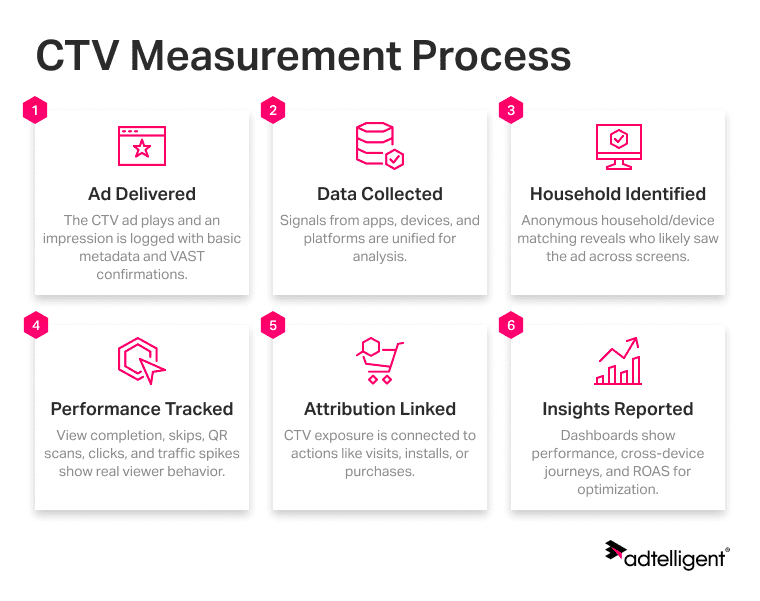
How the process works:
Ad Delivery & Impression Tracking
First, the ad is delivered on a connected TV (via an app, streaming service, or SSAI). At that moment, the system logs an impression along with basic data such as:
- time and date
- app or publisher
- device type and platform
- ad creative and campaign ID
In CTV, this is often confirmed through server-side logs and VAST events to ensure that the ad was actually shown and (ideally) completed.
Also, there are attention metrics showing how long viewers actively look at an ad. Research from Dentsu and Lumen indicates:
- 15s TV spot → 7.5 seconds of attention
- Non-skippable YouTube → 5.2 seconds
- Skippable YouTube → attention collapses after five seconds, often focused on the skip timer
Short exposure can still create recall but recall alone doesn’t predict sales. Each environment demands different creative strategies, for example, immediate branding on YouTube due to early drop-off.
Attention is a proxy metric, not the final goal, but it helps advertisers optimize for awareness and outcomes.
Data Collection & Integration
Next, raw data is collected from different sources:
- CTV apps and streaming platforms
- CTV devices and operating systems
- ad servers and SSPs/DSPs
This data is then brought together in one place so that ad delivery, viewability, and engagement signals can be analyzed rather than in silos.
Audience & household identification
The system then tries to understand who saw the ad — not as a named person, but as a household or anonymous viewer.
To do this, it uses:
- household-level identifiers
- anonymized IDs or device IDs
- IP and device graph signals (where privacy rules allow)
- sometimes third-party or platform-level insights
This step is what enables CTV-to-mobile or CTV-to-web journeys to be recognized: someone sees a TV ad and later acts on another device in the same home.
Performance tracking
Now we look at behavior. This is where “results” start to show up:
- Did viewers watch the ad till the end?
- Did they pause or skip?
- Did they scan a QR code on screen?
- Did they click a companion banner on mobile?
- Did traffic to the website or app spike after exposure?
These signals connect ad exposure to real-world actions, even though the CTV environment itself is often non-clickable.
Attribution
CTV attribution measures how CTV ads influence consumer actions like website visits, app installs, or purchases. We’ll talk about il later.
Reporting, modeling & optimization
Finally, all of this data turns into a report and dashboards. Advertisers receive insights on:
- reach, frequency, VCR
- cross-device journeys
- conversions and ROAS
- top-performing placements
with added layers of fraud filtering and privacy-compliant modeling.
If you want to explore how different CTV ad platforms handle measurement, attribution, and cross-device journeys, see our overview of top CTV ad platforms.
Why CTV Needs Server-to-Server Measurement (CAPI)
CTV doesn’t support cookies and rarely supports pixels, which makes client-side tracking unreliable.
Conversion APIs (CAPI) solve this by sending conversion events directly from an advertiser’s server to the ad platform.
CAPI ensures:
- more complete and accurate attribution
- fewer missed conversions
- better cross-device linking
- stronger privacy controls
Agencies now treat CAPI as a foundational CTV ad measurement tool, with some brands seeing up to 130% increases in conversions and major improvements in ROAS. Adoption is growing quickly as major platforms, like LinkedIn, Reddit, Amazon DSP, Yahoo DSP, Meta, and Google, improve interoperability with first-party data tools like CDPs and CRMs.
CAPI is becoming essential for a truly cookieless attribution model.
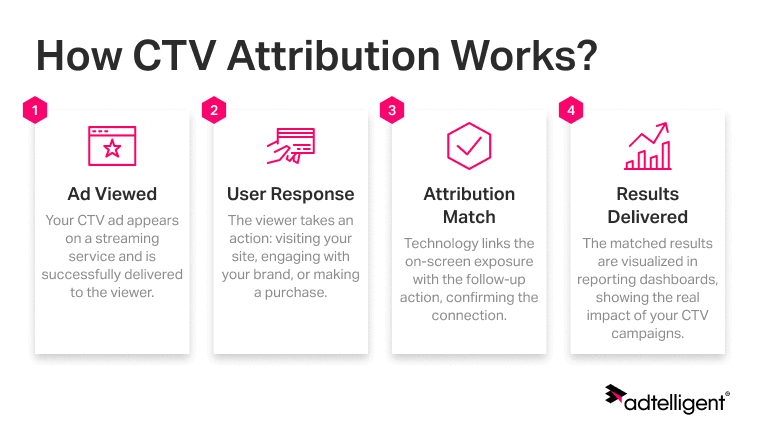
What Is CTV Ad Attribution and How It Works
We’ve already mentioned what CTV ad attribution is. It links CTV ad impressions to cross-device behaviors, helping advertisers understand which campaigns drive real outcomes.
It gives advertisers clear answers to key questions:
- Which ads are driving conversions?
- Which audiences respond best?
- How effective is our media spend?
CTV ad attribution relies on technologies like:
- Identity graphs to match household or device activity across screens.
- Tracking pixels and SDKs to log actions like page views or installs.
- Cross-channel data integration to understand the full customer journey.
- Offline measurement tools (e.g., location data, POS syncing) to tie CTV exposure to in-store visits or purchases.
These signals feed into attribution platforms that provide actionable insights, helping marketers fine-tune creative, targeting, and frequency strategies—ultimately reducing wasted spend and boosting ROI.
What a Modern Attribution Stack Must Support
IAB Tech Lab outlines several requirements modern attribution must support:
Flexible Reporting & Custom Dimensions
Advertisers expect CTV reporting to match digital standards: breakdowns by campaign, creative, publisher, device, audience segment, and time.
This requires conversion events to carry flexible labels and be retrievable across multiple dimensions to avoid CTV becoming a “black box.”
Custom & Multi-Touch Attribution Models
Most emerging attribution APIs support only basic models like last-click or last-touch.
But advertisers, especially those investing heavily in cross-screen and CTV journeys, need more:
- Multi-touch attribution
- Brand-specific or product-specific models
- Cross-device and household-level attribution
- Configurable lookback windows
To unlock this, ad servers must support event-level processing. That means the ability to combine conversion events with exposure events and run custom logic on top of them.
For CTV, this is essential to correctly map:
- CTV ad exposure → mobile app install
- CTV QR scan → website visit
- CTV view → online purchase
- Household impression → device-level conversion
Multi-touch is not a luxury, it’s the only realistic way to measure non-clickable environments like CTV.
Fraud-Resistant Attribution
Shifting attribution logic into on-device agents opens new fraud vectors. Without proper controls, attribution data could be:
- spoofed
- replayed
- triggered by bots
- manipulated by compromised apps
Advertisers need assurance that CTV ad measurement is valid and verifiable. According to Rakuten TV’s latest report, transparency and trust now outrank pricing and scale among UK advertisers, with 97% citing transparency as a major investment barrier. Only 28% feel confident their CTV ads appear in fully viewable, fraud-free placements, leading to a shift toward curated, premium marketplaces.
Despite this, CTV investment continues to rise: 74% of UK marketers expect to increase budgets over the next three years, especially if transparency improves.
A modern CTV ad server must therefore include:
- IVT (invalid traffic) detection at the impression and conversion level
- anti-tampering safeguards
- bot filtering
- device-level and household-level traffic verification
- signed event payloads or secure API frameworks
Trust is a core requirement for attribution — not an add-on.
Next-Gen Cross-Device Attribution
Emerging APIs unlock new measurement possibilities:
- web-to-app and app-to-web attribution
- CTV-to-mobile via QR codes
- CTV-to-web journeys
- cross-device CTV ad measurement within the household
- attribution for non-clickable environments
These are now critical for understanding real viewer behavior across screens.

How Emerging Standards Are Shaping Attribution
Industry momentum is shifting toward:
- on-device measurement
- privacy-first APIs
- secure, event-level reporting
- standardized frameworks across environments
The W3C Attribution API is at the center of this evolution, supporting conversion measurement, aggregated reports, privacy-safe signaling, and customizable logic — without enabling user tracking.
These standards will become the unified approach for web, mobile, and CTV as cookies fully disappear.
The Future: Privacy-First, API-Driven, Cross-Device Attribution
Traditional video ad tech can’t handle today’s fragmented devices or privacy rules. A modern CTV ad server should offer:
- accurate server-side impression tracking
- household and cross-device attribution
- built-in IVT and fraud protection
- privacy-safe measurement without cookies
- CAPI support for reliable conversions
- clear, unified reporting
Adtelligent CTV Ad Server brings all of this together so advertisers can run transparent, trustworthy, and performance-driven CTV campaigns.
Attribution is moving toward:
- secure, on-device computation,
- privacy-centered frameworks,
- API-based interaction,
- support for new cross-screen journeys,
- standardized measurement across environments.
For CTV advertisers, this is transformative. Instead of fragmented signals, we are moving toward unified, verifiable, cross-device attribution that works across web, mobile, and TV screens without relying on third-party cookies.